29 September 2026
30 Years of XaoS
On 19 September, we celebrated the 30th anniversary of the first release of
XaoS,
a free fractal zoomer and morpher. The event was announced on Facebook,
in the XaoS application, on the users'
and developers' mailing lists,
on the website
of the Jírovcova 8 secondary school, on the website
of The Union of Czech Mathematicians and Physicists, and on the Hungarian
Unix Portal. The most official announcement can be found here.
We met at Gymnázium Jírovcova 8 in České Budějovice. It is Jan Hubička's alma mater.
Back in 1996, he and Thomas Marsh, two young programmers with
an interest in mathematics, started the XaoS project merely for
fun. It turned out that they had pioneered an exciting project
that inspired many others to contribute to it or to use the
software in related projects.
About 15 participants attended in person (among them Jan), while between 5 and 10 people joined online
(among them Thomas). They followed
two contributed talks given by Jonathan
Wolfe and me.
After I summarized
some highlights of the past 30 years, Jonathan gave examples of how the
Fractal Foundation uses fractal software,
including XaoS, in its educational work, teaching young learners
about the beauty of fractals.
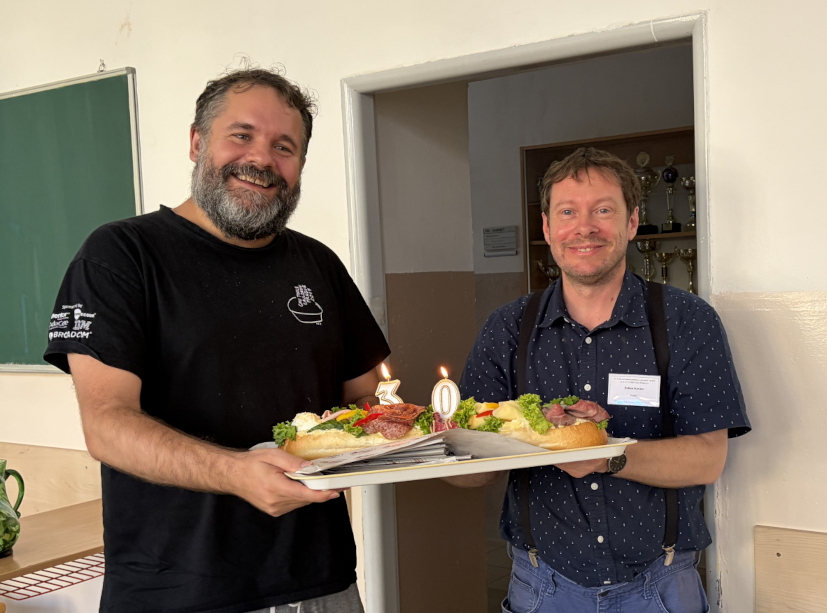
The organizers from Gymnázium Jírovcova 8, with the wonderful support of
its deputy director Lenka Kudrličková and former teacher Roman Hašek,
presented a special gift to Jan to commemorate the past years. Sandwiches, cookies and refreshments
were provided
with the support of the České Budějovice branch of
The Union of Czech Mathematicians and Physicists.
Jonathan's trip was financially supported by the Private University of Education,
Diocese Linz, and the Johannes Kepler University,
Linz School of Education, Fachgruppe Mathematik Didaktik, Austria.
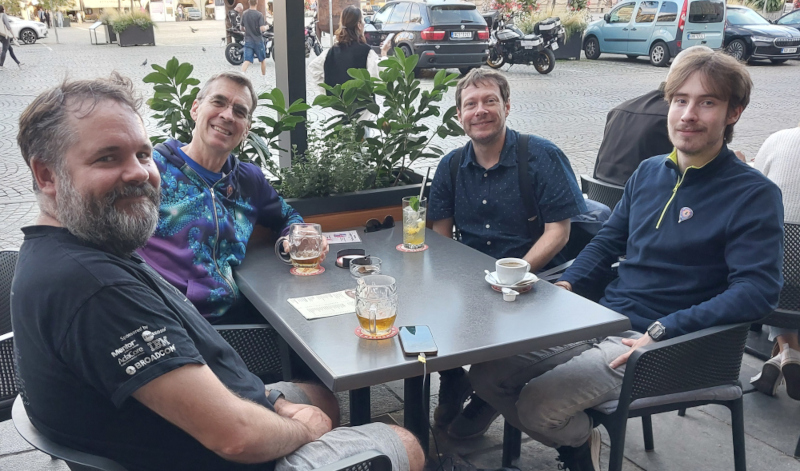
Jan, Jonathan, I, and my son Benedek at the main square of the city
Present and future
XaoS received remarkable support from Google this year when the project was selected
as a mentored project for Google Summer of Code 2026.
Improving XaoS was announced
under the umbrella of the GNU Project. A student from India,
Avinash Sharma, contributed to the project by developing a new platform
targeting mobile devices. His contribution can already be tried out
on Windows.
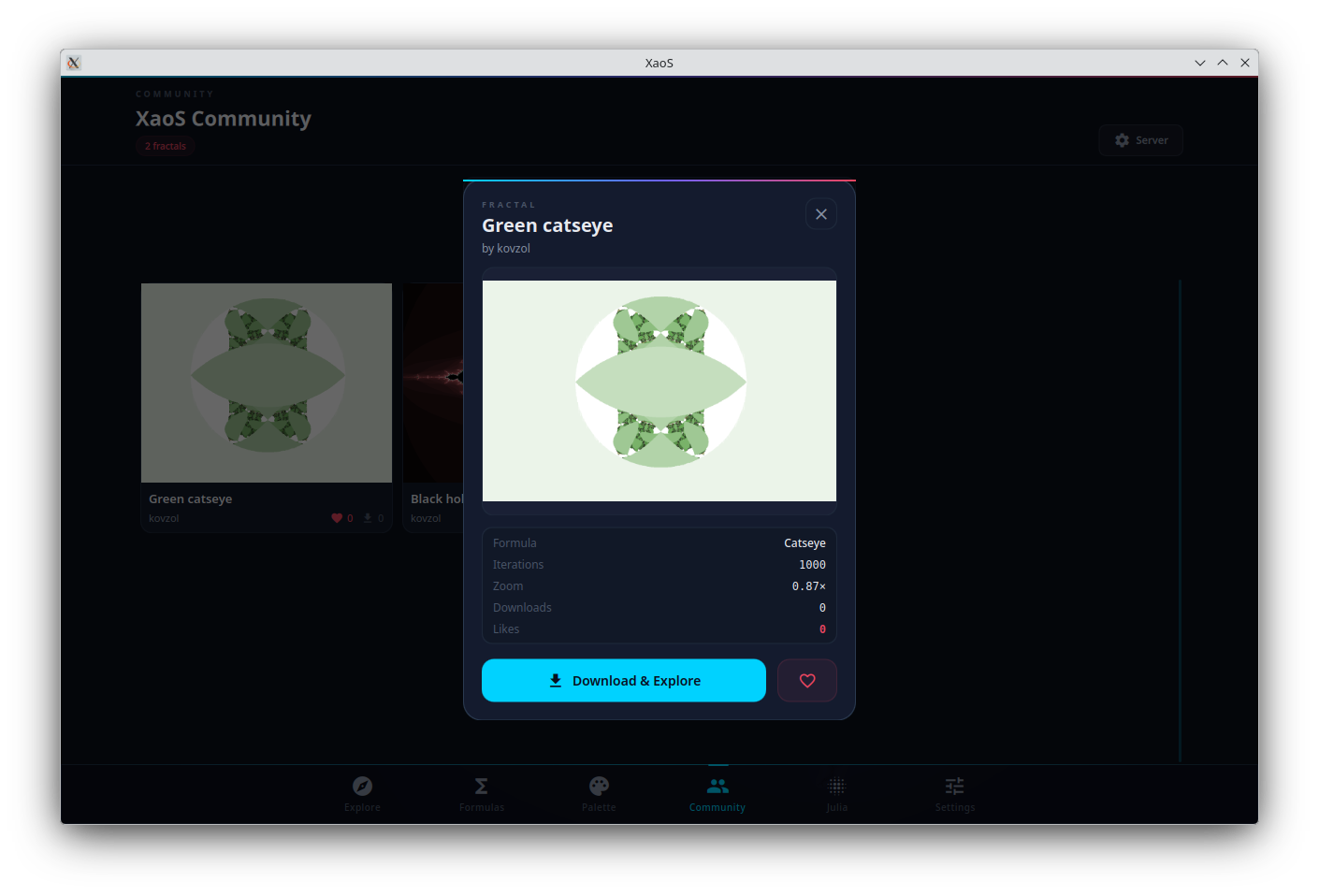
Avinash worked hard on the project for three months. We hope that
his
extensions will soon enable XaoS to become a social network software for fractals,
a kind of Instafractal or FrakTok. At the moment,
we use a temporary server at the Research
Institute for Symbolic Computation that stores and serves the fractal
images created and uploaded by the users.

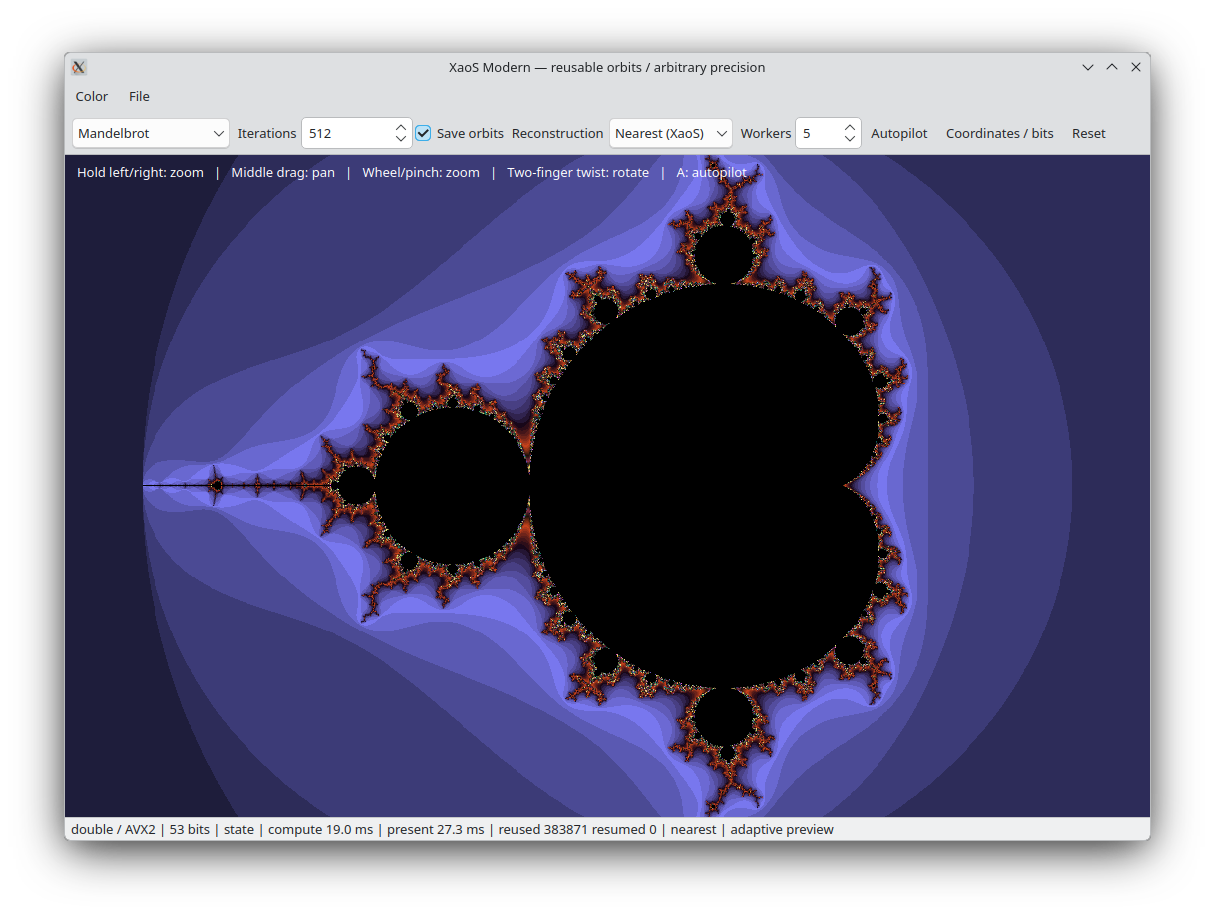
As an unexpected revitalization of the codebase, Jan quickly presented a
complete rewrite
of the main XaoS algorithm in C++, using vibe
coding. XaoS-Modern now compiles smoothly on a recent Linux box
using CMake and Qt
and displays the Mandelbrot Set in its classic XaoS look.
Entries on topic technical developments
- Embedding realgeom in GeoGebra (9 July 2021)
- Web version of Tarski (1 October 2021)
- Developing Giac with Qt Creator on Windows (24 January 2022)
- Compiling Giac via MSYS2/CLANG32 (2 April 2022)
- Terminals on the web (28 June 2022)
- Torus puzzle (15 April 2023)
- Tube amoeba (16 April 2023)
- XaoS in WebAssembly (30 August 2023)
- Debut of GNU Aris in WebAssembly (11 November 2023)
- JGEX 0.81 (in Hungarian) (10 December 2023)
- xaos.app (2 January 2024)
- Compiling and running bibref-qt on Wine (22 August 2024)
- Treasure of Count Goldenwald (6 January 2025)
- Developing C++ code for desktop and web with cmake (7 March 2025)
- Statement analysis in bibref (8 March 2025)
- An online Qt GUI version of bibref (20 April 2025)
- JGEX via CheerpJ (5 July 2025)
- Connecting ISBTF's LXX-NT database with bibref (10 July 2025)
- GraphViz as a WebAssembly module (13 August 2025)
- bibref: Support for LXX 3.2 and StatResGNT 1.4, and some technical infos (23 December 2025)
- Towards reproducible builds via Docker (15 January 2026)
- TeXmacs plugins (9 March 2026)
- Interactive books with TeXmacs via Docker (27 March 2026)
- Syntax highlighting in TeXmacs (13 August 2026)
- 30 Years of XaoS (29 September 2026)

|
Zoltán Kovács Linz School of Education Johannes Kepler University Altenberger Strasse 69 A-4040 Linz |